Lauren Bedula
0:01
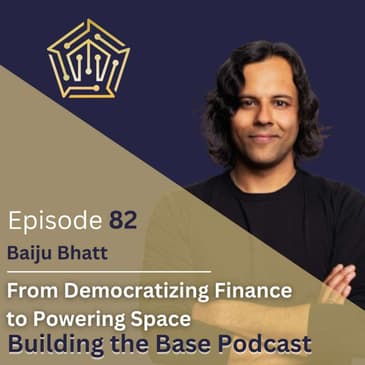
Welcome back to Building the Base. Lauren Bedula and Hondo Geurts here recording live from Simi Valley for the Reagan National Defense forum. And we have a super interesting guest with us right now that I'm really excited to get into everything with. But Baiju Bhatt is the one of the co founders of Robinhood, which don't get me started, big fan and have been an early user of Robinhood, and is now founder and CEO of a space tech company called Aetherflux, which we're going to get into but Baiju, thank you so much for joining us today.
Baiju Bhatt
0:26
What's up?
Hondo Geurts
0:29
All right? So we're gonna have, you know, we always say we get, you know, each new guest is the most interesting background guest, but I think you're gonna break the mold here. So give us, give us the backstory, like, how, how did you get into the you know, not only in the Robinhood, and start that all up?
Baiju Bhatt
0:47
How'd I end up in the Reagan Defense Forum?
Hondo Geurts
0:49
Yeah, with a tie on, talking defense space tech.
Baiju Bhatt
0:53
I showed up yesterday without a tie on, and these guys are making it sound like I showed up with a sleeveless shirt. I swear I was, I was well dressed yesterday, too, but even better today. Yeah, so how do I end up getting here? Long story, let's, let's give you the super long version. No kidding, the moderately abbreviated version. So I've actually grown up around defense and aerospace. Actually my entire life, my family moved to the US from India because my dad had this dream of wanting to study physics. So he starts out at the University of Huntsville, Alabama, and then through all of my childhood, he was a research scientist at Langley Research Center, working with NASA. So I remember these childhood memories, like of going and seeing big wind tunnels and all that scientific stuff and kind of the scale of the equipment. And I was really interested in physics and math as a kid, and my dad was pretty adamant. He's like, look, he's like, I'm not going to tell you to do this. You have to kind of figure it out yourself. It was something really it ended up being the path that I went down. Because in college at Stanford, I studied physics and math. And I think if there had been like any life to the aerospace world back then, I probably would have looked at that a little bit more closely, but instead, I stumbled into finance. So after I did my master's degree at Stanford, pretty soon thereafter, I called up my roommate and one of my best friends from college, and I asked him if you want to start a company with me. So we started finance, kind started a finance company, which didn't go so well, and we started another one, which also kind of torpedoed itself. And then we had the idea for Robinhood, which was really it was actually the idea came up in a conversation between the two of us, but the backdrop at the time was all the stuff going on with Occupy Wall Street, which was actually, like, kind of perplexing. I remember to me, because, on the one hand, like I was the byproduct of, you know, immigrating to the US. My mom was pregnant when she got on the plane to come to the US with me. And so this kind of the US had always been the land of opportunity, right? Like the place where everybody in the world wants to go, and it was just this, like, real head scratcher to see a generation of young people be like, Oh, no. Financial Systems, you know, all messed up. It's rigged. It's not for people young, you know, young people or ordinary people. But at the same time, we're like, this country is the envy of everybody in the world. And like, what's actually going on here? And the thesis behind that was that access to the stock market and the commissions were kind of a microcosm of what people were frustrated by. And we're like, we don't have to do this. So we built a technology company called Robin Hood, which democratized access to the financial system. So that's that. Now, why? Why Aetherflux? Why defense? It's because I had, kind of, I had made this declaration pretty early on, that someday, if I ever got a chance to I wanted to do something in space. Because, I think probably the most frustrating part about growing up in the 90s is it felt like the space race was won and my generation lost, because there was it just wasn't happening anymore. And kind of seeing the access to space, specifically SpaceX, I was like, man, if this is happening in my lifetime, and I don't get to be a part of this like I'm gonna, I'm not gonna feel great about that when I'm when I'm geezer. So I had the idea for for this company. And the the idea is actually around building an energy grid in space. And it's this idea that low Earth orbit is a really unique place for both flying electronics, but also a place to generate electrical power. And in particular, can put things in orbits where they're nearly continuously illuminated by the sun. And you can use, you know, one of the most prevalent forms of power generation on earth to do it, which is solar, right? And if you kind of look into the future, into a world where access to orbit is not altogether dissimilar from like flying across the Pacific or flying across the Atlantic, then you start thinking about commercialization in space on a really big scale. And my hypothesis coming into this was that this was happening in the next five years, and that energy was this very critical vertical of the economy that would exist natively in low Earth orbit. So that's why I am here wearing a tie, talking to you guys.
Lauren Bedula
5:34
So cool. And Hondo and I started this podcast about four years ago, and for us, it's been amazing to see just the folks who are in the room here at the Reagan Defense Forum evolve over even that short period of time. So maybe two years ago, we were saying, wow, it's crazy how many tech companies or non traditionals are here. Last year, we were saying, VCs, but to have a Robinhood co founder, it's like you're really seeing a sector evolve and change. And in this case, it's the defense industrial base. What what you did at Robinhood was, really, you didn't solve a problem, but you changed a sector or a system, and that's what we're trying to do with the defense industrial base, which requires thinking creatively in terms of approach to a problem. Do you have anything to say about that, like, how did you think so big to you said, democratize access to the financial system. And how should we be thinking that way about our defense industrial base?
Baiju Bhatt
6:28
Yeah, I was actually reflecting on this a moment ago when I was walking in and there's a big Palantir sign as you kind of walk into this. And the thought that came to my mind was, if you rewind the clock, like 10 to 15 years ago, kind of around the time that Robinhood was getting started, there were a lot of things that were in vogue, right, that people that were working in the tech industry wanted to do like they wanted to build photo sharing apps. They wanted to build messaging apps. They wanted to build social networks. And these like verticals the economy that were also, you know, very much ripe for a technological revolution with the same kinds of technologies were kind of overlooked. And in retrospect, it's kind of a head scratcher, because you think of Palantir. They were trying to do things in defense at a time when nobody really wanted to work in defense. Somewhat by analogy, we were trying to do things in finance at a time when finance was viewed as kind of icky. And I think there's kind of an interesting thing where there was actually a lot of opportunity in and in a lot of these things outside of the core things that people are working on, the tech industry. The other thing is, is like patriotism is back in vogue in a big way, and I think that's awesome. And I mean, kind of coming back to what I was saying a second ago, the original mission for Robin Hood was to democratize access to America's financial system. And so we had this, like, pretty aggressively America forward view of things. You know, back 2015 2014 at a time when it was, how could that ever not be in vogue? Like, how could be, how could being patriotic be uncool? Like, it shouldn't be. Why is that for you? I mean, look at my life, right? Look at where I came from. I I'm the byproduct of the two people that immigrated to the US from India that came with, like, you know, two suitcases full of pots and pans and a pregnant, non even English speaking mother of mine? And, like, look at the life that I have. Like, this only happens in America. Only happens in America. And I know you, we've obviously talked a bunch before this, but that that's sort of like doing things that are good for this country because this country is so special, and doing things that fundamentally advantage the interests of America. I mean, I think that's like, that's the higher calling, right?
Lauren Bedula
8:56
Here, here.
Hondo Geurts
8:57
So, so I, you know, and thinking of what you're talking about maybe 10 or 15 years ago, I think there was also a thought you could separate national security from national prosperity. And there was, like two camps, like there was the economic camp, and then you military, defense people go do your thing and call us if you need us. I'm also sensing those two communities are merging, yeah, right, because we've got to make sure we continue our economic dominance, and we've got to be secure. You know, thinking strategically. What else can we do to leverage both of those powerhouses? You know, one plus one equals 11, to really not have each go their own way, but be reinforcing.
Baiju Bhatt
9:43
I think, I think it's converging, and I think it's converging because of competition. I think it's, you know, in many ways, kind of like it's very simple and primitive in that way, right? Because a lot of the key technologies that are emerging in 2025 whether it's, you know, the race to build massive scale artificial intelligence, or protecting our nation, it's like it's becoming clear that the fundamental advantage that the United States has is entrepreneurship, and, by extension, capitalism, right? I say this sometimes is like, we're we, as in the United States, like we're not going to out centrally plan the Chinese, like, that's not going to happen. Our government's actually quite bureaucratic and is not that good at central planning. The times that the United States wins, which is, in my opinion, like all the time, is when we bring to bear capitalism, right? And like, when you can put that incentive structure behind technological progress, you get both like rapid execution, and you also get like distinct approaches to it, right? If everything is centrally planned, then you're going to get like one approach, whereas, if you have entrepreneurship, like, every bright eyed and bushy tailed entrepreneur is going to try to, like, do their own thing,
Hondo Geurts
11:09
By design, you get resilience, because you get multiple options, totally, totally, which is important both, I think, in economics and in security.
Baiju Bhatt
11:17
Yeah, also, let's, let's just dunk this one home, right? Like, what are the, what are the great, amazing technologies that have come out of, you know, non capitalist economies, like, name them, right? Like your iPhones, where did they come from? They came from America, right? Where? Where was artificial intelligence kind of brought to, you know, to the forefront, United States of America, right? Where did televisions become popular? America? It's every major innovation in our society, in my opinion, is American, and that's not an accident. It's because we have capitalism.
Lauren Bedula
11:53
Hell yeah. And on the topic of resilience, I love that you weren't shy about the two companies that you started and didn't see through any lessons learned from that experience too. For we've got a lot of founders entrepreneurs that listen, any advice?
Baiju Bhatt
12:09
Yeah, a lot of, lot of pieces of advice. I think you have to kind of be pretty adaptable, like your first idea may not be the the idea that you do forever and ever, got to be willing to fail quickly. Can't get too attached, kind of related to that, to specific solutions, but sort of to wanting to succeed.
Lauren Bedula
12:31
And that's great advice for our government listeners as well. I love hammering that in and on that note, so you built a company, a very successful company in a highly regulated market, the financial sector. But you weren't selling into the government, right? You were navigating like policy and regulatory implications at Aetherflux. Do you see the US government as a customer? How are you thinking about that? Are you seeing hurdles to date?
Baiju Bhatt
12:56
Yeah, I think this is, well, first of all, as an entrepreneur, for me, sort of a little bit of a tangent on a personal note, like doing something that I haven't necessarily done before, that's part of the challenge, is part of the fun, right? Like there's, there's a reason I'm trying to do something that's not exactly, you know, down the path that I've already been before. So, and in this case, we're building an energy grid in space. And we think the first applications for this are going to be collecting power in orbit and being able to directly beam it down to places where there's no existing infrastructure, but at the same time, there's also a tremendous demand for power, right? Like these are the sorts of things that the US government cares a lot about. And so the interesting part of this is that the US government, the Department of War, is going to be, you know, as we look forward, one of the primary places that this technology comes to life. So it is, it is a new challenge. It's pretty interesting. I think the idea is, is that if we can make what we're doing work in that context, that actually gives us the scale and the ability to, like, drive the cost of all the component technologies down to be able to make this a commercial application in the future as well, right? So, kind of thinking of solving problems for the US government and really trying to systematically advantage in the US government on a path towards the thing that wins long term, which is capitalism and competition.
Hondo Geurts
14:30
Yeah, so I often, you know, when, when I look at, you know, successful people, successful folks like you, they've got this great mix of, I call it bold humility. They're, you know, not afraid to act, but they're not afraid to learn. Yeah, you know, and you've been very successful in one thing. You're trying something by design, completely outside of your previous experience. How do you keep yourself humble so that you don't, you know, unknowing? Thinking, wow, I was right this first time. I've got to be right the second time. Well, how do you keep that human, that humble factor, so that you don't kind of walk yourself into a blind path, or let or let this happen? Well, he did this thing, great. So he must know everything on how to do this new thing.
Baiju Bhatt
15:17
That's it. That's a pretty interesting question, because I, kind of, I try not to change too much as a human being, you know, like, if I, if I start looking at the world through the lens of, like, oh, you know, I've had this success, or that success, like that wasn't what got me there. And I'm trying to do that again, right? Yeah. And so you kind of, you kind of, want to go back to the place where it for me, at least like, it's a combination of like constraints, right? I think constraints breed creativity. They've also on the case of humility here, like spaces, what we're trying to do is extraordinarily difficult, and we really want to succeed at it, and so coming in with a lot of bravado is not necessarily the recipe for success, right? The recipe for success is being diligent, systematic, really trying to understand the problem space, like poking holes on all the corners and making sure there isn't something that we haven't like thought about, sort of trying to, you know, be in power from space.
Hondo Geurts
16:20
But you know, somebody once told me, you should never feel fear failure. You should always fear regret, yeah, right. And, you know, taking on something like this, you get, you know, for a lot of our listeners who can sometimes get caught in that fear of failure, the fear of not trying, yeah, is the, you know, something really to be thoughtful on too.
Baiju Bhatt
16:41
I like to get my failures out of the way quickly, right, and just like you know you're gonna fail, just get past it pretty quickly, um, and try not to wait too long until you fail. Like this. These are all kind of like startup truisms. But it actually is true, because if you're if you get too attached to an idea, and you don't actually want to pressure test it or see if it's going to break. You can stay in that place for weeks, months, years, where the better thing to do is just like, don't get too attached to it. Try it. It fails, learn, do it again.
Lauren Bedula
17:12
Awesome. And so I know we've talked kind of big picture, but on Aetherflux, are you going to democratize access to energy? Because on the energy piece, we haven't really had a lot of folks from the energy from the energy sector on, and it's such a crucial part of our defense industrial base. Like, talk to me a little bit about the energy aspect and your vision there.
Baiju Bhatt
17:35
Yeah, that has a nice ring to it. Our vision for this is to build a power grid in space, right? To build, more specifically, an American power grid in space, because we think we're at a really unique time where, like, access to energy hasn't been a flashpoint in the economy or society like it is right now. I don't know. Maybe since, like, World War Two, maybe?
Hondo Geurts
17:55
1970s OPEC oil prices, maybe?
Baiju Bhatt
17:58
Yeah, the energy prices of 70s is a good, good analogy as well. So the point I'm trying to make is, I think it's like one of the most, if not the most problem, important problem the economy is solving. And I think shy of a lot of new ideas and a lot of progress on this, like we're going to end up really, really straining the energy grid. And so one of the core ideas behind this is actually take some of that really energy hungry applications and kind of put them above the grid, right? Like actually put the super hungry power applications and take them outside of the energy grid. So these are kind of more longer term thoughts and more to come on that soon.
Lauren Bedula
18:39
Awesome. Any final thoughts? I know you've got a busy day here, but is there anything you can tell our listeners that we didn't talk about today? Any final thoughts?
Baiju Bhatt
18:49
Yeah, that's a good that's a good question. I mean, I think it kind of comes back to seeing the the defense sector and the defense industry kind of get a group hug from Silicon Valley. That's actually hugely important for America, right? Like, we want these two very important parts of our society to be working in concert. And I think that's like the biggest thing that I see here. Like this feels like Silicon Valley in ties in many ways, as opposed to, you know, the defense industrial base in ties.
Lauren Bedula
19:24
Isn't that wild? Baiju, thank you so much again. Know you're busy guy, really excited to see what you're building. Thank you for taking the time to talk to our listeners about your story that got you here and where you're going from here.
Baiju Bhatt
19:35
Totally, yeah, this is awesome.
Lauren Bedula
19:37
Thanks, Baiju.