Lauren Bedula
0:00
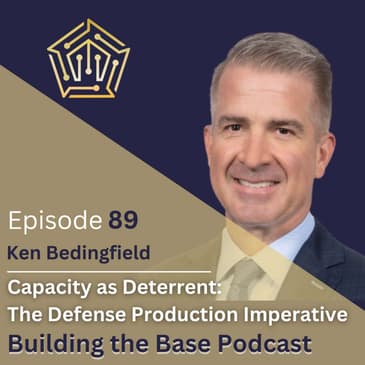
Welcome back to Building the Base. Lauren Bedula and Hondo Geurts here recording live from the Reagan National Defense forum in Simi Valley. Our guest here with us now is Ken Bedingfield, who is Chief Financial Officer for L3Harris and also president of Aerojet Rocketdyne, so wearing several big hats, but has spent time in leadership roles at traditionals startups, and now kind of in between there. So Ken, so excited to dig in with you today.
Ken Bedingfield
0:27
Yes Lauren, Hondo, it's great to be here with you guys. What a fantastic location to to be at today, and great, great set of discussions here at the Reagan Defense Forum so far today. And look forward to the conversation.
Hondo Geurts
0:40
Yeah, Ken, well, good to see you again. You know, you've been in the business for a long time, in a bunch of different roles, but maybe, you know, turn back the clock a little bit. How, you know, where did you kind of grow up? What was your, you know, interest area in national security, and how did you wind up? You know, now all the way fast forward a couple years. You know, in holding two pretty key roles in our industry.
Ken Bedingfield
1:04
Yeah, well, thanks, Hondo, very, very polite way to say I'm old and can't hold a steady job. But no, look, I would say, you know, my interest in defense, I think you know, really grew out of, you know, where I started my career, you know, being based in DC, early on, got into the defense industry. Really fell in love with, you know, trying to do what I could to, you know, help the defense industrial base. Certainly support the Department of Defense, I suppose, now the Department of War, you know, with what we could do to provide, you know, technology, and, you know, maybe as importantly these days, you know, really capacity in terms of product for for the war fighter, and so it's become a passion. I've always wanted to stay in defense. You know, I spent a number of years at one of the large defense primes left there, and actually thought I was going to take a little bit of time off. My oldest kids were seniors in high school, and I thought I'd spend some time with them. Turns out 18 year olds don't want to spend that much time with you. So I ended up going back, going back to work. And I went to one of the technology startups, and I spent time at a venture backed company called Epirus that was doing counter UAS. It was a blast. And so having the experience of, you know, the big, traditional defense prime, the young, you know, fast moving. You know, I was to call it the 20th employee at a venture backed startup. You know, it is a diverse set of experiences. And now I'm at l3 Harris. And you know, we are, I would say, kind of the tweener between a prime, a traditional and a technology startup, where, as you know, the trusted disruptor. It's more than a tagline. I mean, it really is a culture within the company. We try to move fast. We make, I think, every bit of as good a decision as the as the big guys, but I think we make them in days, not weeks or months. And you know, it's a small group of us that that get together, I think, have good information, good data, and decide and go and move. So been having a great time at El tree Harris. It's a great team. And, you know, we really try to be again, you know, that company that kind of spans the gamut of traditional and and startup.
Lauren Bedula
3:41
And I definitely want to pull apart your specific experience more. But before I do that, so we mentioned, you've had interesting roles in the industrial base over over a period of time. What's your take on the evolution of the industrial base?
Ken Bedingfield
3:56
You know, it's really, it's really interesting. I mean, I would say, you know, for a long time it seemed like it was about requirements, requirements, requirements, and constantly chasing, you know, that last bit of capability or technology. And it really feels like today it's about capacity. And, you know, capacity as as a deterrent, and so I really sense that there's a change to, you know, whether it's a recognition that that capacity, in fact, can be a deterrent, or whether it's the fact that we just don't have enough capacity today, given, you know, the world as it is, recent events, whether it's war in Ukraine or, you know, you know, the war in Israel. You know, whatever it might be. So I do get a sense that, you know, there's a move more to not only capacity, but moving fast. You know, we've talked about acquisition reform. I get a lot of questions like, acquisition reform, is that only. But for, you know, the new entrance is that meant for those companies, I will say at L3Harris, we're very excited about acquisition reform. You know, our CEO wrote a letter to Doge and suggested some of these same changes, whether it's, you know, getting rid of CAS, whether it's commerciality, reducing requirements, you know, doing more on a centralized, you know, kind of the PAE type basis. We're very supportive of all that. About 20% of our sales today come through a commercial model. We do think, you know, we need to talk about what the definition of commercial is, because I would love to sell more and more of our product on a commercial type basis, but we don't sell them commercially. We don't sell solid rocket motors to consumers. But I do think to the extent we're investing and agreeing to go right into fixed price, it ought to be essentially a commercial model. So we need to talk about what that means.
Hondo Geurts
6:03
We talk, you know, your, your comment on capacity, chicken and egg, you know, is it just because we're shorter, because we want it? I think, I think, you know, we may want both, but certainly solid rocket motors is, you know, right there on top of the list of an area where we've had a hard time meeting capacity, as you you know, do this great dual role job of yours. Besides, you know, running CFO for major corporation, also being a president, how are you thinking about boosting capacity in solid rocket motor? And what are, what are some of those key enablers? You know, whether it's supply base or raw material, or building new plants that you guys are focused on to really ramp up capacity to the point we need it as a nation.
Lauren Bedula
6:49
And can I add to that? Could you do a quick solid rocket motor 101, for dummies, asking for a friend?
Ken Bedingfield
6:55
Sure, yeah. So, yeah, a couple things in terms of solid rocket motor 101. I mean, think of us as a solid rocket motor company, essentially as a chemicals company. We mix propellant from different base chemicals. We will pour those propellants into cases they often need binding materials, you know, insulation or other binders, to make sure that they appropriately will cure to the case. And then you shape essentially, a cavity inside of that solid motor so that you get the appropriate amount of oxygen and air burn in there, and that will define at what rate the motor burns. It burns generally from the back to the to the front, and will give you a specific amount of propulsion. It'll burn for some number of seconds, and it may take you a 50, 100 200 or more miles, depending on the motor. So really, you know, not a lot of moving parts. Oftentimes no moving parts in a solid rocket motor. Some of them will have what's called a DACS, or a divert and attitude control system. Some will just have an attitude control system, which are, you know, smaller motors that will fire off the side to basically steer the missile into its target, which is, you know, particularly important from an interceptor perspective. And we, we are on just about every interceptor program today and every interceptor program to come. So that's a little bit about about solid rocket motors. I hope that helps. And then Hondo, to your question, I would say, you know, first thing I do want to say, look, we are very, very focused on capacity. At the same time we're also focused on technology. We want to make sure that we're continuing to invest. We don't want to get caught in the do loop of just in just investing for kind of those current programs. So we continue to invest in lots of interesting technologies, of all things, solid rocket motors, liquid fuel engines, hypersonics, we got solid and liquid and dual source ramjet, scramjet engine. So really amazing and incredible talent on the technology side, but from the capacity side, I would say, first of all, you know, we bought Aerojet Rocketdyne about two and a half years ago, and, you know, first thing we did, or one of the first things we did, was increase capex by about 3x to 4x with a recognition that we really needed to invest In the business as it had been working through some challenges between, you know, being sold, you know, a proxy fight, you know, things like that. They just hadn't quite had the opportunity to invest as much in the business. So we did that. We've certainly been, you know, smartly investing. I just call it good old industrial engineering, finding the pinch points, fixing those not trying to fix everything. So whether that's you need another oven, you need, you know, the ability to do more. You know, casting automation, we've been doing a lot around automation, robotics, you know, things like that, to to accelerate production as well. And then you know very, very clearly, working closely with our suppliers. Because, to your question, we can't do it alone. We've got to go in concert with the missile primes, and maybe more importantly, we need the suppliers of cases, nozzles, igniters, chemicals, you know, to be able to come along, come along with us. So we're working in the entire ecosystem. What do we need to invest? How do we get there? What can we do today to start to climb the ramp? We will be investing, and we are investing in new factories. You may have seen we we've been working with the government on a new factory for gmlrs, Stinger and javelin. We've broken ground on a new factory for large solid rocket motors, also in Camden, Arkansas, and we're going to, we're going to add to that an annex to do medium sized solid rocket motors, think kind of all things, interceptors. So we'll add that to that capability, and then we're going to likely do another about half a billion or more investment in orange Virginia to do also medium size, so medium size and tactical solid rock motors. So a lot going on on the capacity side, very important that we work with all the suppliers to make sure they're making the investments, because we can't invest and then be waiting on parts, and then also, to the extent worth, you know, kicking motors out the door. You know, 2x 3x 4x here, two years, three years down the road, we need the primes to be ready to accept those motors, integrate them to missiles, have seekers, you know all those things. So it's a complex ecosystem. Of course, nothing in the defense world seems to be simple.
Lauren Bedula
12:07
Let's dig into the interceptors a little bit more. And I'm surprised we haven't, with guests today, talked about Golden Dome at all, but I know very much a priority for the administration and Department of War. What are some best practices? Like, how do you go about I hear so many companies interested from like the sensor side to the AI side to actual interceptors. Like, how do you build an infrastructure like we're envisioning?
Ken Bedingfield
12:32
So when it comes to the the missile shield for our homeland, I would say, you know, I think about it really, as a set of capabilities, many of which exist today and either need to be accelerated and or, you know, improved upon from a technology perspective. So we've obviously got sensors in space today that can track and do missile warning, missile defense, and we've got positions on Space Development Agency, tranche 01, and two. We're looking forward to tranche three getting awarded. You know, we had put up a prototype hbtss. We've been clear that we could get another constellation up to protect the homeland from hypersonic threats before this administration is out of office. So, you know, from a sensor perspective, I think there's more to do in terms of sensor fusion, how the sensors share data, you know, from one part of the constellation to another, down to the ground, triggering the intercept, letting that interceptor know where it needs to be. In particular, when it comes to a hypersonic threat and a maneuverable hypersonic threat, and I think there get to be some challenges there, but you know, we're, I think, uniquely qualified. We've got the sensors, we've got some of the you know backbone, or you know equipment, or for the command and control and the communications of of the constellations, as well as to the ground. And then we're, as I mentioned, we're on every interceptor program, so we know what it takes to do do the intercept. And you know, I think that there are, you know, continued advancements in the interceptors. We're excited to work with. You know, the primes on, whether it's next gen interceptor, glide phase interceptor, you know, there's some other opportunities coming out. I think they've been talking about low cost interceptor. So we're, I think, well positioned on all those but importantly, in those regards it exists today. It's accelerating and advancing. I think ultimately the net new is the space based interceptors. So think of that as putting missiles in a garage on a satellite in space, essentially, and then launching those to try to catch a. Um threats, in theory, I would say earlier in their trajectory, to the extent they're ballistic, or earlier in their flight. If they're not, it's more of a challenge. I think that'll that'll take more of the ultimate missile shield budget we certainly have, I think, a lot of capability in that regard, between our our space business at SAS, certainly Aerojet in terms of propulsion. You know, we have space rated propellant as an example. So I think, you know, we're just thinking through all the ways that we can help the customer to solve those hard problems. And, you know, I think it's one of the beauties of of our business, with a diverse portfolio, as well as we have kind of a business model agnostic approach. So we can prime, we can sub, we can merge and supply, we can kind of see where we fit best.
Hondo Geurts
15:59
So you've got a great experience as you talked about as prime as a venture back, startup CEO, and now back as a tweener. How do you see the industrial base, you know, changing or actually leveraging all of those unique kinds of capabilities better? And then, you know, over time you've got a corporate element of the company. What's your advice to some of these startups or scale ups who are pretty early in their cycle? How do they best talk to you guys, talk about their capabilities, you know, and leverage that relationship to help them build scale as they're maturing as companies.
Ken Bedingfield
16:43
Well, I think you know first thing, first is it's important that you know you recognize what you're good at, and you don't try to be everything to everybody. And I think that we've taken a great approach to that at L3Harris, we know what we do. We understand our products, and you know, we're not going to try to be, you know the solution to every problem. Sometimes the answer just is, hey, that's not, that's not for us. But in terms of, you know what we do, the question then becomes, how do you best bring advancements in technology or capabilities to that mission? And I think we're very good at providing mission capability to customers, and so, you know, as an example, you know, we have, I think, world class electro optic, infrared sensors. The question then becomes, could you ingest AI into those sensors, or into the computing of those sensors to do real time targeting, rather than sending it back to a operation center to have a bunch of humans do it. And then the question becomes, should we do that? Are we world leaders in, you know, computer vision, artificial intelligence, analyzing, you know, millions or billions of pixels at once, probably not so we've partnered in that regard with Palantir to ingest their technology. And that's the way, you know, I kind of think about it, or I think we think about it at L3Harris is we're kind of the connective tissue between technology, which is great, but mission capability, which is what the customer actually needs. And that's the way we kind of think about it. You know, we do have a number of positions in technology companies, so we've invested in either directly or indirectly through shield capital, you know, probably, I think we've got probably direct investments in a handful of companies actually, including epris, where I was previously CEO, back before I was with L3Harris. And then we're also probably have, you know, I would say 10s or dozens of investments that we've made through through shield capital. But I think it comes down to, you know, really understanding number one, that these companies care and are committed to the defense industry, defense industrial base, and our war fighter. And then you know that that technology aligns to mission capability and that we can move fast together. Because I think, you know today, when it comes to these relationships, you know, they're like, they're like cheese, they don't, they don't get better with age, I guess, except blue cheese, maybe. And so the question I always ask the new technology companies is, Hey, are we moving fast enough? Are we able to keep up? And generally, the answer is, yeah, you know, L3Harris, we find, is moving faster than than the other experienced defense companies.
Lauren Bedula
19:55
I'm going to give you a little bit of a curve ball, because we already talked about the energy that. Out here today, and sort of the different groups, non traditionals, traditionals, certainly government. What do you do? You have any predictions about, like, three years from now, what we might expect in terms of energy in the industrial base ecosystem, or maybe changes you're observing now that might be more prevalent in a few years?
Ken Bedingfield
20:18
You know? I think from that perspective, you know, I think that we will see a move to, you know, again, more of a commercial model. And I think of that again as fewer requirements, defining what you can bring, what missions you can accomplish with the capability moving faster, fixed price, contracting, self investing in R and D, and getting capability out there a heck of a lot quicker. So I think that that's one, you know, again, I think capacity is important, and I think it's great that we have new entrants. And I was at a new entrance, so I love the ecosystem, but it's important that the new entrants, you know, really think about, you know, can they scale? Do they need a partner to scale? I mean, if I just go to solid rocket motors for a minute, you know, we're in Camden, Arkansas. We have 2500 acres, 200 buildings, a lot of specialized facilities, you know, very specific regulations around explosive loads and how much work you can do, how much you can store, how much you can ship, you know, into or out of any particular facility. Our safety record is impeccable, and safety, obviously, is the most important thing we can do, but it's very it's very specialized, and in order to scale, you've got to make sure you understand how you do all of that. And so I would, you know, say to some of the new entrants, can you scale? How can you scale? Do you need a partner to do it? Because I do think, you know, capacity is going to continue to be a theme for years to come. And it's not just in solid rocket motors. I think it's kind of across the ecosystem. And look, we're very comfortable in this scenario, and then hopefully less less bureaucracy and less regulation, if we could eliminate cost accounting standards, you know, some things like that, where we could move faster. I can't tell you how many times there's things we want to do that are good for the business, and then we end up having to kind of negotiate, well, that's in that CAS entity, and not that CAS entity. And can I do this? And I need to get somebody, somewhere in the department, to approve or agree or sign off, and it slows things down a bit. I think the customer wants to move fast. We want to move fast, and we need less regulation to do so.
Hondo Geurts
22:51
So, you know, that was kind of where my question was going to go. If we can achieve that, there's, there's kind of a myth around that a public, publicly traded company can't move fast, can't be innovative. You know, it was kind of last year's story. If we can resolve some of these, I would say low hanging fruit of just getting out of, you know, getting out of our own way is your sense that, you know, a publicly traded company with the right view and the right kind of focus can be agile, and actually, you know, continue to be a valued contributor in this versus everything's got to be kind of venture backed or privately funded. You've kind of lived in both worlds.
Ken Bedingfield
23:33
So yes, I absolutely the answer is yes, and I'll say it like this. You know, at some point we all have to pay the piper, and we all need to be, you know, meaningful, profitable, you know, cash flow generating businesses, that's sort of the point of being in business is creating a return for your shareholders, certainly creating good product for your customers. You know, there's an entire ecosystem. That makes sense there. At some point, the new startups have to figure out how they're going to get, you know, to that point, whether it's, you know, they get bought by somebody, or they, you know, row enough to make some money. I like, I like, a challenge. It's not easy as a public company, you know, with quarterly targets and earnings per share. And how do we do all of our, you know, free cash flow, and investors and we, we might, you know, have some other things we need to do with our cash, whether it's, you know, paying down some debt or whatever it might be, but yes, we can figure out creative ways to invest in R and D, and we do it today. I mean, as an example, for 20 years in our communications business, we've been investing our own R and D. We don't charge the government for the radio investment in T com, and we'll be transitioning. And it's the same with West cam and the EOIR sensors I mentioned, and we'll be transitioning some of the others to that model. It's not going to be the easiest transition, you know, quarter to quarter. We'll have to work through that, but we've got our eyes on what it takes to get there, and certainly not easy but, but we like a good challenge.
Lauren Bedula
25:18
Awesome, Ken, well, and we know you're very busy out here and really appreciate you taking the time. It's rare to see someone who's kind of served in leadership roles across the industrial base like you have. So thank you so much for sharing your stories and best practices with our listeners.
Ken Bedingfield
25:31
Oh, thank you. Thanks for having me. It was a great discussion. I appreciate the opportunity, and just fantastic to be again here Reagan and to represent the all the employees of L3Harris.