Lauren Bedula
0:00
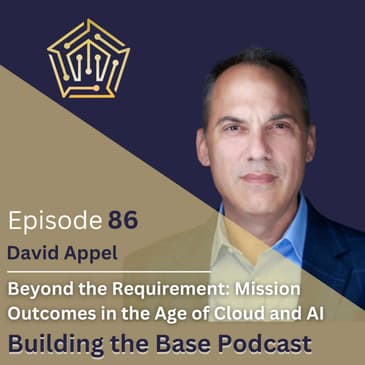
Welcome back to building the base. Recording live from the Reagan National Defense forum in Simi Valley. Lauren Bedula and Honda Geurts here with our guest, David Appel, who's Vice President of Global Government for Amazon Web Services, so major business worldwide. Dave, we're excited to jump in here.
David Appel
0:16
I'm glad to be here. It's great to be here for the discussion.
Hondo Geurts
0:19
So Dave, we normally start out just kind of a little bit of a background for you, kind of, Where'd you grow up? You know, what? What path did you get? Did you always wanted to be an AWS guy when you were in high school? Or, you know, how'd you get from there to here?
David Appel
0:32
Yeah, I'm a good old western Pennsylvania blue collar boy, and moved down to Washington, DC in the early 90s, and I spent the following 28 years at Raytheon and its legacies, legacy companies. And so I've grown up in the government space, but three and a half years ago I came to AWS. Was a chance to do something different, innovate. Saw how the cloud was transforming, how missions are done, and it was an exciting opportunity. I jumped on it, and it's been a it's been a great ride since
Hondo Geurts
0:59
And what did you see is the difference, you know, what were you expecting? And did that expectation of it being different kind of pan out or,
David Appel
1:10
Well, you know, I think we still like to think of ourselves as the world's largest startup, and we still are the world's largest startup. In my opinion, the innovation that we do, the way we think about problems, differently think about the customer, we think long term, all things that I was expecting going in. And it's, it's been, it's been a great experience.
Lauren Bedula
1:30
And you've seen the industrial base over a very interesting period of time, and play an incredibly important role in it. Now, at AWS, can you talk a little bit about the evolution of the industrial base that you you've saw during your time at a traditional and now as a real strong non traditional player?
David Appel
1:48
Yeah, you know, I think the biggest thing that I'm seeing is, and one of the things that really appealed to me, even coming to AWS, is that there's such a focus on the customer and the customer needs, not the requirement, right? The industrial base has grown up over decades, and Honda, you know this previous role, it's all about the requirement. Give me the specification I'll deliver to that requirement. How we're talking about what are the mission outcomes you really need? And let's figure out the right solutions and technologies to get to those answer and and with the cloud, and Cloud enables AI, and Astro with AI, the possibilities are endless right now. So it's really exciting. And I think the government with the far rewrite that's on, that's going on right now, in the way that the current administration is talking, we're really talking about, what are the mission outcomes we need, and allowing the innovation occur, both in the traditional companies, the non traditional, the startups. It's kind of opening the door for innovation that I don't think we've ever seen before.
Lauren Bedula
2:42
And you are an important partner to so many both traditional and non traditional players. Can you talk a little bit about best practices that you see on the teaming side, or finding companies to partner and enable with? Or are there major differences across that spectrum?
David Appel
2:58
You know, I think probably it probably could be grouped into the large companies and the smaller companies a little bit a little bit different, generally on the larger companies I would, I would say it starts with the leadership, because there's a little bit more layers in a larger company. You really need leadership buying to be willing to do things differently, to think differently, and drive that down in the organizations and also traditional companies have grown up also trying to do everything themselves. And where I found in my career, where we spent majority of our time was things on like, what's the underlying infrastructure versus what's the mission, or what's the problem. And so when we had a program that wasn't going well, is on the rudimentary infrastructure and getting the infrastructure to work, versus focusing on the mission and the outcome. Well, with the cloud, it frees up large organizations to go focus on what you do best, which is the mission. Let that undifferentiated or that infrastructure be handled by the you know, a cloud provider like AWS. Well, we can take that burden off of them, on the on the smaller businesses. You got to jump right in, right and I think it also folks know, the customers know those missions, and then they should absolutely be leveraging things like the cloud, because they don't have the same resources to go build it on their own, and they can really then deliver the outputs that they want to achieve.
Hondo Geurts
4:20
So, you know, it's, it's been really interesting to watch, kind of the cloud. And, you know, at first government customer, Mike, least my experience in national security was we'll do cloud as long as it's all on prem, right, you know, and just in the cloud, yeah, but they would call it the cloud, and then it was okay, everything off prem, outsource everything. And then may or may not understand what the cloud really is, if you're not with a trusted provider, right where? Where do you see? Where have you seen that journey go, particularly in the national security space, both domestically and maybe globally, to degree, you want to talk about that. And then, where do you see? It like five. Years or eight, you know, sure, what kind of trajectory are we on?
David Appel
5:03
Sure. Well, let's, let's start with, I think you hit some really good work. Not all cloud is the same. Cloud has somewhat become a generic term, and even among the hyperscalers, we're different and really understanding what the differences are of the cloud, how it's from the from the where the sites are, to how they're constructed, to the security that's put around them, to how services are deployed. We're all a little bit different, and being a smart buyer of cloud is really important, versus just saying I'm in the cloud. So for us, we've been at it with the US government for almost 15 years. 14 years now, started with the the CIA, and a big bet they made with a C 2s so we've been at over those 14 years. We like to say there's no compression algorithm for experience. We've built up the ability for across all security fabrics, from top secret to secret to Gov cloud all the way down to just the commercial cloud, of what it takes to operate in the government. And we're still scratching the surface of what's possible with with the US government. And the key thing for us right now, and I think for the government, is AI, leadership for this nation, dominance for the using the administration's terms, is we all agree, as important for the country, but you really can't get to that at scale unless you're operating in the cloud. So the government needs to move more and more into the cloud, not those on prem data centers that they call the cloud. Because again, the same thing will happen with the government. We see how fast GPUs are coming out now, large language models and other next variation of technologies. There's no reason why the government should be spending capex on always again, redoing their infrastructure, versus bringing it to a hyper scaler and then focus on the mission. So I think within the US, there's still a long runway of what's possible in the cloud. From international perspective, I think the internationally, and I'll make a generic, I think they're five to 10 years behind where the US was. They haven't gone all in on the cloud yet. There's infrastructure in various countries being built, and they're starting that journey as well. We just have a head start here in the US.
Lauren Bedula
7:12
And now it's one thing, running a US government business, but as we talked about, you're running them around the world, government and public sector focused businesses. Do you have any advice to those of our listeners that are entrepreneurs, founders or growing businesses, to think about how to navigate, like, what is your strategy as you're thinking about growth and new markets to enter?
David Appel
7:32
Well, for us, beyond just building the infrastructure, we need local partners and what and same here in the US, it's the it's the large businesses and also the small business. They have the mission knowledge. We can help them then take their their mission expertise and bring it to a customer and innovate and change the way things are done. So it's this, it's the same recipe. And know the customer, work with us on what you're trying to achieve, and we can then help move them to the cloud, the company to the cloud, or actually get a customer to the cloud from the footprint that we have globally.
David Appel
8:06
Awesome. And how are you, how are you navigating de globalization, essentially, and navigating that?
David Appel
8:14
Yeah, that's, that's a, that's a great question. You know, it depends on the region. Right? There are certain regions of the world that are a little bit harder to crack right now, a little bit more protectionism than than others. But I'm a firm believer that the technology itself and what the cloud is doing should stand on its own. And and we recognize the importance of sovereignty and but I also envision a day sovereignty today is is is being defined by real estate and the borders in a truly digital world that doesn't exist. And so I think we have to event we're gonna eventually get to a cultural decision, kind of discussion of the security around the data. How do I protect the data? How is have access to data independent of where the data is? We're not there yet in society or globally, but geographic border should be defining it.
Lauren Bedula
9:07
I think it's just so interesting to see, and just you're continuing to be a strong partner with our allies, right? I think the private sector plays an important role in maintaining strong partnerships with allies as we're navigating shoring up critical technologies and capabilities.
Hondo Geurts
9:24
And do you guys see a supply chain problem from your perspective, for the UA, you know, maintaining the capabilities you need? Kind of us, with us, supply chains, have you that forced you to change? So yeah, and have lower tier supply or so?
David Appel
9:40
It's a great question. You know, the the obviously, the highest demand right now is on GPUs. Yeah, and so we work with Nvidia and others on GPUs, but we also saw the need to protect the supply chain, which is why we started investing several years ago, and trainium and Graviton and making our own chips, our own sales. The time. Matter of fact, we just announced the latest version of trainium three for for training models. And so supply chain, and making sure we have that unrepresented supply of these high demand items is very important. And also, when you think about the amount of of chips that are coming out of Taiwan, and if something ever happens in in Asia Pacific region, you want to make sure we have that supply. So that's one reason why we started self investing as well, to have some continuity.
Hondo Geurts
10:24
Yeah, and how about on the talent side? So, you know, there's a little bit, I think, sometimes this misnomer of we don't have the talent in the US. We have to, you know, we're talent. We're, you know, we're people limited. Is the sense you get that it's, I mean, obviously different sectors, different talent, have different things...
David Appel
10:45
it's a challenge we started having just with the cloud. This is, this isn't specific to the US. This is going to be a it applies to everyone the talent, not only for what started first with understanding the cloud, but certainly AI has now just amped that up a little bit to the broader issue. And so we spend a lot of time educating our customers on what the technologies are. They have to get comfortable and trust it to actually buy it. We also have to work with the operator so they can trust it and use it. But then we spend a lot of time even with educational institutions in the broader public to put out training, free training, but also bespoke training as well, because if they don't understand it, they won't use it, they won't embrace it. And I think that's a that's something that we've experienced in every country we operate to,
Lauren Bedula
11:34
That's so exciting. And you also, I think AWS plays a role in creating distributed networks of innovation. And I understand you all have a focus on Florida, maybe next, or the defense Tech Summit down there in West Palm Beach. Could you talk a little bit about, yeah, you know what?
David Appel
11:50
Where we look, we work with our partners and and we're trying to find other areas to create innovation, sandboxes and hubs to drive innovation for the Department of War, but also just the broader government. There's clearly Silicon Valley, and there's Austin, Texas and and working with others where, you know, maybe we'll look at some things in Florida, where we can work, we can set up with our partners, ways to bring people together, innovate, drive new technologies, and focus on problems of the government
Lauren Bedula
12:18
That's exciting. And on the topic of conferences. I know you all have had a presence here for several years at the Reagan National Defense forum. What's your take on today and sort of energy here?
David Appel
12:29
Yeah, you know, it's actually I was coming to someone. This is my, my second out of three year coming to Reagan National Defense forum. And the energy is pretty, pretty high right now. Yeah, more than it was the last, last time I was here. So I don't know, you know, I think it's because the moment we're in right now, moment of time we're in right now with this administration to drive change and innovation and technology, there's a lot of, a lot of energy here to talk about those things, like what we're talking about today.
Hondo Geurts
12:55
Yeah, I think I'd love to get your view, you know, I think for a long time, particularly in, in a startup world, there was, you know, prosperity, and then there was national defense, and they were kind of two completely separate communities, and couldn't, could afford to be separate over the last couple of years. You know, there's a sense, I think, of those coming together. Are you seeing that you can't think about, you know, growing commercially without having a secure national defense, or you can't grow National Defense without understanding the commercial how to leverage our commercial and economic strength as a nation.
David Appel
13:31
Yeah. So two comments. That one is certainly, over the last couple of years, we've seen more commercial organizations, Silicon Valley type organizations, trying to get into our intelligence community marketplaces, the marketplaces we set up for the for the classified businesses they want to come into that, I think they see it's an opportunity space for them. So we help them figure out how to do work with the government. But even when I you know, we're talking about this the forum, one big change I noticed from the last time I was here is the amount of financial institutions that are here. Jamie Dimon is here, and others that wasn't here three years ago. Because I think we're starting to recognize the financial institutions, the financial stability the markets, are just as much about national security as traditional defense would have been. And so I think that, and the investments that they bring to the table, and startups and others. I think it is really driving new entrants to the market, which is really exciting.
Lauren Bedula
14:24
Very exciting. And you talked about just the energy out here and sort of momentum over the past year out of the Department of War, terms of acquisition reforms, just any thoughts on where we stand. We've seen reforms in the past. Do you feel like a cultural shift happening as well?
David Appel
14:39
Or, yeah, you know, again, I think this is a moment in time that things like acquisition reform have been talked about for decades and other sorts of changes. I think this is a moment time where if it's going to happen, it's going to happen now, and I think there's good momentum for it to occur.
Lauren Bedula
14:55
And one more that we like to ask before we close out, but you are a very, very busy man trying. All over the world. How do you stay fresh? Like, how do you stay with it?
David Appel
15:04
Play a lot of golf, okay, but I have a great team. We have some amazing talent on our team. We like to continue talk about how we raise the bar. And when you have a great team that makes it makes it easy,
Lauren Bedula
15:19
Love it. Well, David, thank you so much for taking the time to come on and chat with us today. Loved hearing your your take on the environment.
David Appel
15:26
Well, thanks for having me. Appreciate it.
Hondo Geurts
15:27
Awesome.
David Appel
15:28
Thank you.
Transcribed by https://otter.ai